How to Pay Off Debt: Complete Debt Repayment Guide
Learn how to pay off debt with practical repayment strategies, budgeting tips, debt snowball and avalanche methods, consolidation guidance, and more.
Table of Contents
43 key sections
Key Takeaways
- Know what you owe
- Create a realistic budget
- Choose a repayment strategy
- Pay more than the minimum
- Avoid adding new debt
- Build for the future
How to Pay Off Debt
The first step in learning how to pay off your debt is to realise that you don't need a perfect financial position in order to make progress; all you need are a clear idea of what you owe, a realistic repayment plan and a system which you can carry on using month after month.
The method you choose will vary according to your income, your expenses, the interest rates, the amounts you owe, and your financial goals. Although some people find the debt snowball method helpful, others prefer the debt avalanche method since it targets interest costs. In certain cases, debt consolidation, refinancing, changes in spending, or getting professional help might also be suitable.
The aim is not just to carry out payments but to set up a sustainable system which lowers your balances without causing any new financial difficulties.
The guide shows you how to organize your debts, select a repayment strategy, reduce the amount of unnecessary interest, cope with financial difficulties, and establish habits that will aid you in staying free from debt.
Why Paying Off Debt Can Be Difficult
There are several reasons why paying off debt can be difficult.
In the first place, interest can raise the total cost of the loan. If a large part of each payment is going towards interest rather than towards the principal, the balance may decrease more slowly than one would expect.
Second, having several debts can make it confusing to repay them. You could have a credit card, a personal loan, a student loan, a vehicle loan, a medical balance, or some other obligation, each with its own interest rate, due date, and minimum payment.
Third, unforeseen expenses may disrupt your plan; for example, a car repair, a household bill, a change of job, or some other financial emergency could cause you to have to use credit once more.
In the end, settling debts involves balancing current needs with future objectives; it may not always be practical to send all the money you have towards debt if that leaves you unable to meet your basic expenses or deal with emergencies.
A plan for sustainability must therefore be aggressive if it is to make progress yet at the same time realistic in order to maintain it.
Start by Listing Every Debt
Before you decide on a method of paying off your debt, make a full list.
For each debt, record:
Creditor or lender
Current balance
Interest rate
Minimum payment
Payment due date
Loan term, if applicable
Whether the rate is fixed or variable
Any fees or penalties that may apply
Whether the debt is secured or unsecured
A simple debt inventory might look like this:
Credit Card A | $3,000 | 24% | $90 |
Credit Card B | $1,500 | 19% | $45 |
Personal Loan | $7,000 | 11% | $180 |
Student Loan | $12,000 | 6% | $130 |
What the exact figures are isn't as important as having a full and correct picture.
When you have made the list, work out the total amount of debt and the total of the minimum monthly payments.
This gives you two important starting points:
The total debt is the amount that you owe in total.
The amount you have to pay each month is the lowest amount necessary to keep your accounts up to date.
Don't depend completely on your memory; check the statements, the loan accounts, and the other records to make sure that smaller balances are not been missed.
Calculate How Much You Can Pay
The next thing you should do is work out how much money it is reasonable to allocate towards paying off debt.
Begin with the income you receive each month and then deduct the necessary expenses such as:
Housing
Utilities
Food
Transportation
Insurance
Healthcare
Minimum debt payments
Necessary family expenses
Other required obligations
The remainder is the amount you could pay an extra towards your debt.
You should not automatically direct all of the remaining money towards debt.
A little flexibility can make it easier to stick to a repayment plan. When your budget leaves no room for unforeseen expenses, a small financial emergency could once again lead you to take out a loan.
A useful approach is to create three categories:
Essential expenses
Financial protection
Extra debt repayment
The financial protection category may consist of an emergency fund and other reserves which are suitable given your situation.
The amount you assign to each category will vary according to your financial circumstances.
Choose a Debt Repayment Strategy
After you have worked out how much you owe and the amount you can afford to pay, select a method.
The two methods which are being discussed most are the debt snowball and the debt avalanche.
Both methods usually consist of keeping up the necessary payments on all your debts while at the same time putting extra money towards one particular debt.
The point is in the way you choose that target.
Debt Snowball | Smallest balance | Quick visible progress |
Debt Avalanche | Highest interest rate | Interest-cost efficiency |
Consolidation | Combined eligible debts | Simplification or potentially different financing terms |
Neither of the two methods gets rid of the need to prepare a budget; the approach is only effective when you continually allocate more money to the debt you have selected.
The Debt Snowball Method
The debt snowball approach arranges the debts starting with the one having the smallest balance and going on to the one with the largest balance.
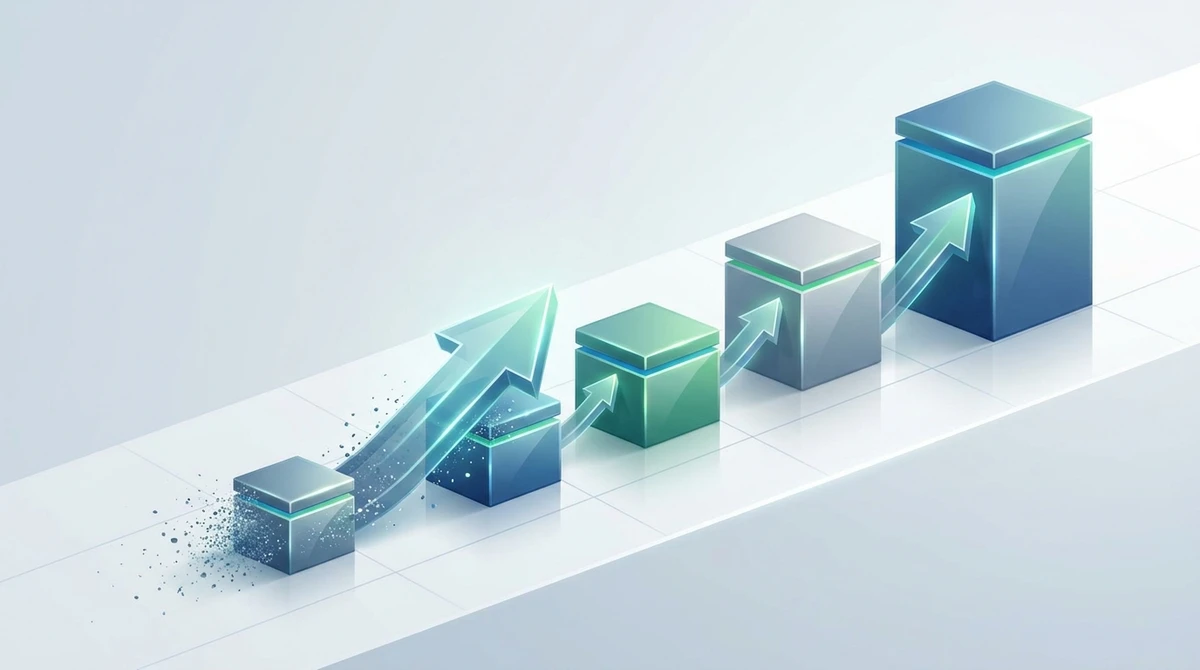
You continue making minimum payments on every debt. Put any extra repayment money toward the smallest balance.
After the smallest debt is paid off, you redirect the money that had been going toward it to the next smallest debt.
For example:
Debt A: $500
Debt B: $2,000
Debt C: $5,000
Debt D: $10,000
You would focus extra payments on Debt A first.
After Debt A is eliminated, you direct its previous payment amount toward Debt B, while continuing required payments on the other debts.
This creates a progressively larger payment toward the next debt.
Why people use the snowball method
One potential advantage is psychological momentum.
Paying off a small balance can provide a clear milestone. Seeing an account reach a zero balance may make the overall process feel more manageable.
The trade-off is that the smallest debt may not have the highest interest rate. Depending on the numbers, another strategy could cost less in interest.
The Debt Avalanche Method
The debt avalanche method prioritizes debts according to interest rate, generally targeting the highest-rate debt first.
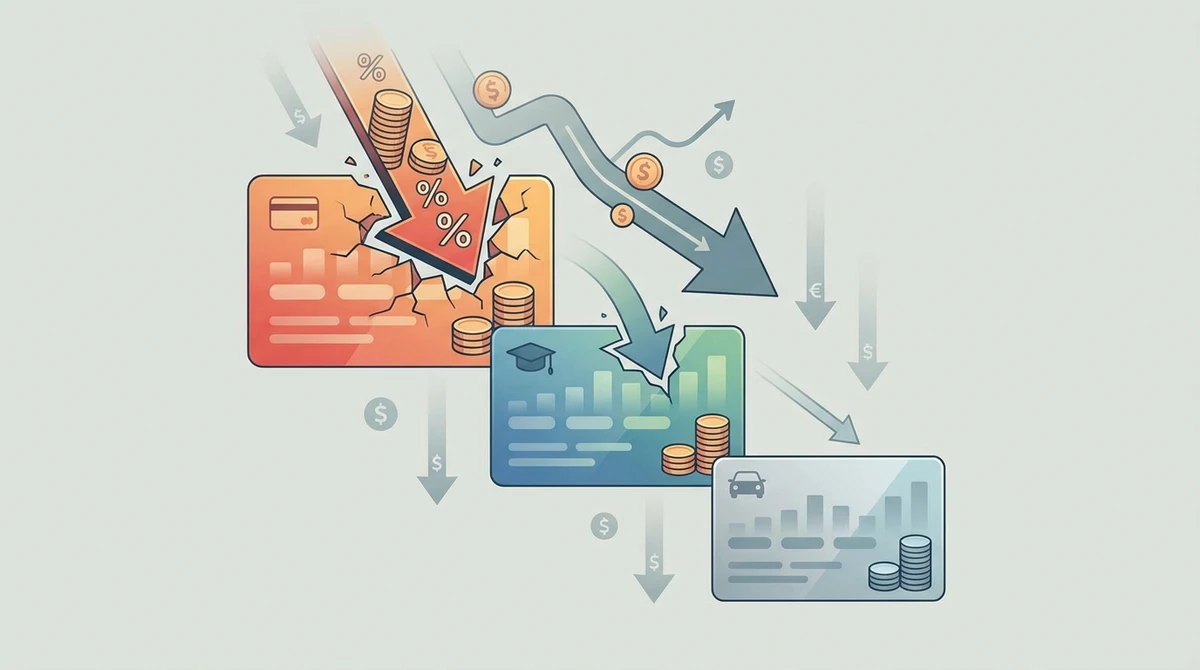
Suppose you have:
Credit card: 25%
Personal loan: 12%
Student loan: 6%
Under an avalanche approach, you would generally direct extra money toward the credit card while continuing minimum payments on the other debts.
After the highest-rate debt is eliminated, you move to the next-highest rate.
Why people use the avalanche method
The cost of holding debt is influenced by interest rates, and by directing extra payments towards balances with higher interest rates you can decrease the length of time during which those balances are exposed to high borrowing costs.
The avalanche method might involve more patience when the debt with the highest interest rate has a large balance.
Snowball vs. avalanche
The choice balances motivation with interest costs.
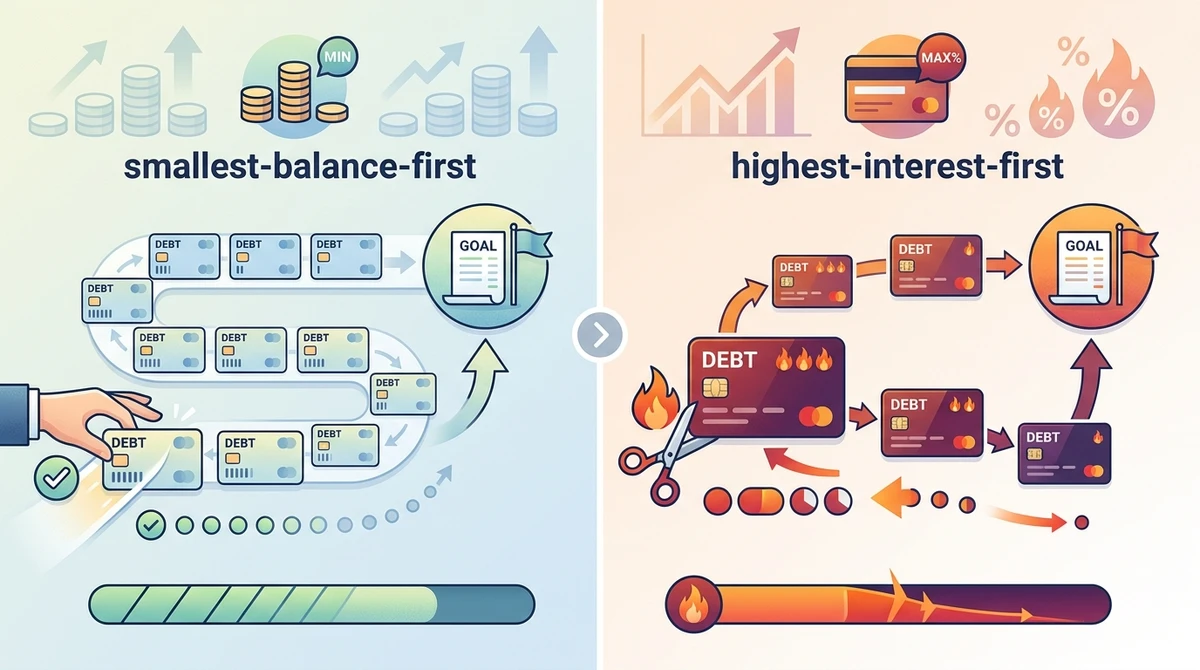
The snowball method may seem easier to follow if you use visible milestones to stay consistent.
If your main concern is minimizing interest costs, the avalanche method gives you a simple way to prioritize the debt with the higher rate.
The best strategy is the one you understand and can carry out consistently in your situation.
Debt Consolidation
Combining various debts into a single new debt involves terms which depend on the product and the lender.
The potential benefits can include:
Fewer payments to track
A simpler repayment schedule
Potentially different interest terms
A clearer monthly payment
That does not mean that the debt is reduced simply because of consolidation.
You could reduce the monthly payment by extending the repayment period, even though you'd pay more interest over time.
Before consolidating, compare:
New interest rate
Fees
Loan term
Monthly payment
Total amount repaid
Whether the rate is fixed or variable
Consequences of missed payments
Any collateral requirements
It is also worth thinking about why the debt accumulated.
The monthly burden may remain even if consolidation reduces it, since the previous credit accounts are put back into use at once.
How to Reduce Your Interest Costs
Interest can strongly affect how fast debt disappears.
One way to reduce the interest you pay is to focus on the debt with the highest interest rate. Options vary by debt type and your eligibility.
You might investigate:
Lower-interest refinancing
Refinancing could lower your borrowing costs if you qualify for a loan at a lower rate. Instead, compare the full terms, not just the stated rate.
Balance transfer offers
Certain credit cards provide promotional terms for transferring balances. Offers may include fees and have a promotional period, so read the terms carefully.
A promotional rate is not permanent.
Negotiating with creditors
In some cases, and depending on the creditor, you can ask about hardship schemes, payment plans, or other options.
Do not assume a creditor will change your terms. Ask what programs are actually available and request the terms in writing when appropriate.
Paying more than the minimum
Additional principal payments can reduce the outstanding balance faster, although the exact effect depends on the debt's terms.
Before making large additional payments, check whether your loan has any restrictions, fees, or other conditions.
How to Create a Debt Repayment Budget
A debt repayment budget turns your goal into a repeatable system.
Start by calculating your average monthly income.
Then organize spending into categories:
Housing | $1,200 |
Utilities | $250 |
Food | $450 |
Transportation | $300 |
Insurance | $200 |
Minimum debt payments | $400 |
Other essentials | $300 |
Available for extra debt payment | $300 |
This is only an example. Your actual numbers may be completely different.
The key is to identify expenses you can reasonably reduce without making the budget impossible to maintain.
For example, you might review:
Subscriptions
Restaurant spending
Entertainment
Shopping
Unused memberships
Delivery fees
Insurance costs
Mobile plans
Recurring digital services
Avoid cutting essential expenses to make a repayment plan appear faster.
How to Pay Off Debt Faster
Once your basic plan is working, look for ways to increase your repayment amount.
Increase your income
Additional income can accelerate debt repayment without requiring every cut to come from your existing lifestyle.
Depending on your circumstances, possibilities may include:
Overtime
Freelance work
Part-time work
Selling unused items
Consulting
Seasonal work
Monetizing an existing skill
Directing some or all of additional income toward debt can increase your monthly repayment amount.
Use occasional windfalls carefully.
Tax refunds, bonuses, gifts, or other unexpected money can potentially be used for debt repayment.
However, consider your emergency savings and upcoming essential expenses before committing the entire amount.
Automate payments
Automation can reduce the chance of missing a payment.
At minimum, schedule required payments by their due dates when your account balance allows it.
For extra payments, automation can also help turn debt repayment into a routine rather than a decision you have to make every month.
Stop adding new high-cost debt.
Paying off an old balance while continuously adding new balances can keep you trapped in the same cycle.
During repayment, review what causes new borrowing.
If unexpected expenses are the problem, build financial reserves.
If the problem is regarding discretionary spending, then set spending limits.
If your income isn't enough to cover essential costs, look for ways to increase your income or reduce your fixed expenses.
What to Do When You Cannot Afford Your Payments
The issue isn't always a lack of proper financial planning; your monthly payments may be too high compared to your income.
If you are having trouble making your minimum payments, take action as soon as possible.
Contact your creditors, explain your circumstances, and ask whether any hardship schemes, adjusted payment plans, temporary assistance, or other options are available.
You might also consult a qualified financial counselor or some other reputable professional.
Be wary of companies that promise to eliminate your debt or guarantee quick results.
Before paying a debt-relief company, understand:
What services it provides
What fees it charges
How payments are handled
What happens to your accounts
Whether creditors must agree to the proposed arrangement
What risks may exist
What alternatives are available
If you are facing legal action from creditors, worry about going bankrupt, or are experiencing other serious financial difficulties, seek appropriate professional advice.
Common Debt Repayment Mistakes
Trying to repay everything without a plan
It may seem productive to make occasional extra payments, but a clear strategy makes it easier to track your progress.
Ignoring interest rates
You might miss balances that need attention if you never check your interest rates.
Focusing only on the monthly payment
Just because the monthly payment is low doesn't mean the debt is cheap; consider the interest rate, term, fees, and total repayment cost.
Emptying all savings
Putting all your savings toward paying off debt can leave you vulnerable to unforeseen expenses.
The right balance varies by situation.
Taking on new debt during repayment
More borrowing could offset the progress you've made.
Using credit for recurring expenses
When income fails to meet regular expenses, relying on credit can create a difficult cycle to escape.
Expecting immediate results
Big debts often take a while to pay off.
A slower, more sustainable plan may be more useful than an aggressive one that fails after a few months.
How to Stay Debt-Free
Achieving long-term financial stability involves more than just paying off debt.
Once you eliminate a balance, redirect part of the money you previously allocated to debt toward your next financial goal.
That might include:
Building an emergency fund
Saving for major expenses
Retirement contributions
Education
A home purchase
Other long-term goals
You should also identify the behavior that first led to the debt.
Ask yourself:
Do I regularly spend more than I earn?
Were unexpected expenses responsible?
Did I use credit for essential purchases?
Was it the case that interest rates were making balances hard to manage?
Should I not have had an emergency fund?
Was irregular income a difficulty when it came to budgeting?
You can use your answers to design an improved system.
A Simple Debt Payoff Plan
If you want a straightforward starting point, follow these steps:
Step 1: Write down each debt.
Write down balances, rates, minimum payments, and due dates.
Step 2: Calculate your monthly cash flow.
Determine how much income remains after essential expenses.
Step 3: Protect essential expenses.
Do not build a repayment plan that prevents you from paying for necessities.
Step 4: Establish an appropriate financial cushion.
Consider emergency needs and affordability.
Step 5: Choose your repayment method.
Compare the snowball and avalanche approaches.
Step 6: Pay every required minimum on time.
Avoid turning one debt problem into another.
Step 7: Direct extra money toward your target debt.
Keep your strategy consistent.
Step 8: Roll freed-up payments forward.
Once a debt is gone, redirect the amount originally assigned to it to the next goal.
Step 9: Review your progress regularly.
Update balances and adjust the budget when income or expenses change.
Step 10: Build long-term financial habits.
Once you bring debt under control, allocate cash flow to savings and other objectives.
Frequently Asked Questions
1. What is the quickest method of paying off debt?
Since different people have different fastest methods, the outcome varies based on debt balances, interest rates, income, expenses, and the amount paid. Generally, you can pay off debt faster by paying more than the minimum required and focusing on the highest-cost debts, as long as the strategy remains affordable.
2. Whether I should pay off the smallest debt or the one with the highest interest rate first?
The debt snowball method focuses on the loan with the smallest balance, whereas the debt avalanche method focuses on the one with the highest interest rate. The snowball method emphasizes quick wins, while the avalanche method emphasizes prioritizing loans by interest rate.
3. Is it advisable to save money as I am paying off my debt?
If you have emergency savings, you can often cover unforeseen expenses without taking on new debt while you pay off your debt. The right amount varies based on your income, expenses, job stability, current savings, and the cost of your debt.
4. Is it a good idea to consolidate debt to pay off debt?
Debt consolidation can simplify several payments and may change your borrowing terms, but it will not automatically lower the overall cost. Before deciding, compare the interest rate, fees, repayment period, monthly payment, and total amount to be repaid.
5. Is it possible to pay off debt without sticking to a strict budget?
You can make additional payments even without a formal budget, but it's usually easier to know how much you can afford to pay toward debt when you know where your money goes. All you need is a basic spending plan; it doesn't have to be complicated.
What steps should I take if I can't pay the minimum amount required on my debt?
Contact your creditors as soon as you can and ask what hardship measures or payment arrangements they offer. You could also look into getting advice from a reliable financial counselor. If your situation includes serious legal or insolvency problems, you may need the right kind of professional advice.
7. Is it a good idea to use a credit card to pay off another credit card?
You can sometimes transfer debt between credit cards through a balance-transfer plan, but the details matter. Consider transfer fees, promotional periods, standard interest rates, and your ability to avoid building up more debt.
8. What time is required to get out of debt?
The timeline will vary based on your total balance, interest rates, minimum payments, any extra payments, and the income available to pay off the debt. You can use a debt payoff calculator to estimate the timeline based on your real figures.
9. Is it advisable to use my extra income to pay off debt?
Earning extra income may increase your repayment amount and could even shorten the repayment period. But consider your essential expenses, emergency savings, taxes, and other financial priorities before deciding to spend the full amount.
10. What happens after I pay off my debt?
Once you eliminate a debt, redirecting at least part of the former payment toward savings or another financial goal can turn debt repayment into long-term financial progress.
Conclusion
Learning how to pay off debt is primarily a process of organization, prioritization, and consistency.
Start by identifying exactly what you owe. Calculate your available cash flow. Cover essential expenses, then choose a repayment strategy that fits your priorities.
The debt snowball can provide clear short-term milestones by targeting smaller balances first. The debt avalanche focuses on higher-interest debt. Consolidation may simplify repayment in some cases, but you should evaluate its costs and terms carefully.
Whatever approach you choose, avoid relying on unrealistic budgets. Make required payments on time, direct additional money toward a defined target, monitor your progress, and address the reasons new debt develops.
The ultimate goal is not simply reaching a zero balance. It is to create a financial system that makes borrowing less necessary and lets the money previously used for debt payments support savings and other long-term goals.
Admin
Finance writer and investment analyst at FinFlexa, helping readers make smarter money decisions with data-backed guides and calculators.