What Is a Credit Score? How Credit Scores Work and How to Improve Yours
Learn what a credit score is, how credit scores work, what affects them, and practical ways to improve your credit score and build stronger financial health.
Table of Contents
46 key sections
Key Takeaways
- A credit score is a number that helps lenders assess your credit risk.
- Payment history is one of the most important factors affecting your score.
- Credit utilization matters, and lower revolving credit balances are generally better.
- Longer credit history can help demonstrate responsible credit management.
- Too many new credit applications can negatively affect your credit profile.
- Checking your own credit report generally doesn't hurt your score.
- Paying bills on time is one of the best ways to build strong credit.
- You don't need to carry a credit card balance or pay interest to build credit.
- Checking your credit reports for errors can help protect your score.
- Improving credit takes time, so consistency matters more than quick fixes.
Credit Scores: What They Are and How to Improve Them
It is one of the most important figures in finance because it affects whether you get a loan or credit card, the interest rate you're offered, how much you can borrow, and other financial decisions.
What constitutes a credit score? How is it calculated? What makes it increase or decrease? And what steps can you take if you have a poor credit score?
This complete beginner's guide explains how scores work, lists the factors that affect them, and gives practical steps you can take to improve your credit over time.
The essential thing to realize is that a credit score is a figure that forecasts the probability that you will repay the money you have borrowed, the forecast being made based on the information in your credit history; the higher the score, the smaller the credit risk and the easier it is to qualify for favorable borrowing terms.
What is a credit score?
A credit score is a figure calculated from your credit report that helps lenders assess how likely you are to repay borrowed money under the terms of a credit agreement.
Lenders and other businesses may use credit scores when evaluating applications for products such as:
Personal loans
Mortgages
Auto loans
Credit cards
Lines of credit
Other financial products
The higher your credit score, the less risk it seems to a lender and the greater your chances of approval and more favorable loan terms.
Credit scores are usually calculated using statistical models; instead of examining each part of your financial history, the scoring model converts relevant credit information into a number.
In other words, your credit score indicates financial risk.
What is the difference between a credit score and a credit report?
Credit reports and credit scores are closely related, but they are not the same.
Credit report
A credit report includes details about your credit history and accounts.
Depending on the country and reporting system, a credit report may contain information such as:
Credit accounts
Loan balances
Credit limits
Payment history
Account opening dates
Account status
Delinquent accounts
Collections
Credit inquiries
Certain public records
Credit score
A credit score is a figure calculated from the details in your credit report.
Think of it this way:
Credit report → Information about your credit history
Credit score → Numerical assessment calculated from that information
An error in your credit report can therefore affect the score calculated from that report.
How is a credit score calculated?
When you apply for credit, a lender wants to answer a relatively simple question:
"How likely is this person to repay the money?"
Instead of relying entirely on subjective judgment, lenders can use credit scoring models.
The scoring model reviews your credit history and assigns a score.
A simplified process looks like this:
Your credit activity → Credit report → Scoring model → Credit score → Lender's risk assessment
For example, let's say two people apply for similar loans.
Person A has:
A history of paying bills on time
Low credit card balances
Several years of credit history
Few recent credit applications
Person B has:
Several missed payments
High credit utilization
A short credit history
Multiple recent credit applications
The scoring model could give Person A a higher score because the available information indicates a lower probability of repayment problems.
A credit score does not ensure that a person will repay a loan because it is only a statistical forecast, not a way to predict the future with certainty. People already find it difficult enough to predict tomorrow's weather, so it's an ambitious request to expect a three-digit figure to forecast your entire financial future.
What factors affect your credit score?
Different scoring models use different formulas, and their factors and weights may differ.
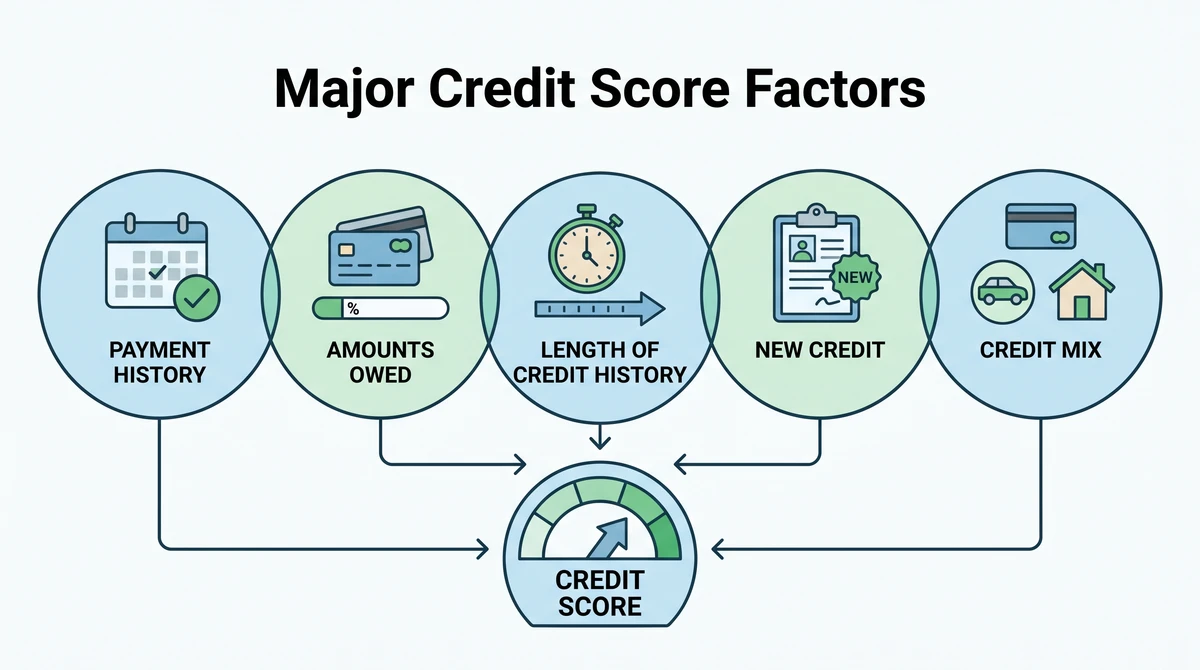
The FICO Score is one of the most well-known systems. It bases its scoring models on five main categories of information:
Payment history | 35% |
Amounts owed | 30% |
Length of credit history | 15% |
New credit | 10% |
Credit mix | 10% |
These percentages are general guidelines, not a universal formula for every case. The degree of importance of various factors may differ according to a person's credit profile and the scoring model in question.
Let's examine each factor.
1. Payment History
In most credit scoring models, payment history is the most important factor.
It examines whether you have fulfilled your credit obligations as agreed in the past.
This can include:
Credit card payments
Loan payments
Other reported credit accounts.
Late payments
Missed payments
Accounts in collections
Serious delinquencies
Certain public records, depending on the scoring system
Within the FICO framework, payment history accounts for about 35% of the score.
What is it about payment history?
A lender wants to see evidence that you can repay money reliably.
A person who always pays their bills on time is better proof of taking responsibility for borrowing than someone who frequently fails to make payments.
How to protect your payment history
Consider:
Setting up automatic payments
Using calendar reminders
Keeping enough money available for scheduled payments
Paying at least the required amount by the due date
Contacting your lender if you expect difficulty making a payment
The simplest credit-building strategy is also one of the most boring:
Pay your bills on time.
Boring financial advice tends to outlast other advice because it works.
2. The amounts due and the use of credit
The other main point is how much debt you have and how much of your available revolving credit you use.
One especially important concept is credit utilization.
What Is Credit Utilization?
Credit utilization refers to the proportion of revolving credit you are currently using out of the amount available.
The basic formula is:
Credit Utilization = Credit Card Balance ÷ Total Credit Limit × 100
For example, suppose you have:
Credit limit: $5,000
Balance: $1,000
Your utilization would be:
$1,000 ÷ $5,000 × 100 = 20%
A high utilization ratio may signal that you're using a large share of your available credit, which could negatively affect your score.
FICO considers the amount owed about 30% of its score, although the exact effect varies from person to person.
Is thirty percent a magic number?
Not exactly.
You will often hear advice saying:
"Never use more than 30% of your credit limit."
See this as a useful guideline rather than a universal law.
Credit scoring models can account for usage in more detail, such as overall usage, usage on each account, and the number of accounts with a balance.
The important principle is:
Lower credit utilization is generally better than being close to your credit limits.
You don't need to carry over month-to-month credit card debt to build a good credit rating, since paying your balance in full helps you avoid unnecessary interest and shows responsible credit use.
3. The length of your credit history
Credit scoring models can consider how long you have been using credit.
This can include:
The age of your oldest account
The age of your newest account
The average age of your accounts
How long particular accounts have been open
In the traditional FICO system, the length of a person's credit history makes up about 15% of the score.
What is it about the length of your credit history?
A longer credit history gives lenders more information about how you manage credit over time.
Someone with responsible credit behavior for ten years provides more historical information than someone who opened their first credit account only three months ago.
This creates a frustrating little financial paradox:
You usually need a credit history to show you can manage credit.
The answer isn't to open many accounts. Instead, build good credit and maintain it over time.
4. New credit and recent applications
Credit scoring models may also take your most recent credit activity into account.
Opening several new credit accounts in a short time can affect your credit score, especially since applications result in hard inquiries.
For example, repeatedly applying for:
Credit cards
Personal loans
Auto loans
Other credit products
In a short time, it can make you seem more inclined to take on credit.
It doesn't mean that you should never apply for credit.
Instead:
Get a credit loan only if you actually need it.
Don't open several accounts just because promotional offers are available.
You will regret it when you look back. The way your future self is responsible is rather annoying.
5. Credit Mix
Credit scoring models may also consider the kinds of credit accounts you manage.
Examples can include:
Credit cards
Installment loans
Mortgages
Auto loans
Other forms of credit
In the traditional FICO system, credit mix makes up about 10% of the score.
You shouldn't take out a loan to improve your credit mix.
It makes little financial sense to take on too much debt to boost your credit score.
A good credit record naturally forms when you use the right financial products responsibly.
What counts as a good credit score?
No single, universally accepted definition of a "good" credit score exists because scoring systems and corresponding score ranges vary.
For example, while many commonly used credit scores in the United States range from 300 to 850, other countries and scoring systems may use different scales.
For that reason, you should always understand:
Which scoring model is being used
Which credit bureau supplied the underlying information
What score range that model uses
What the lender considers acceptable
A score that appears high under one scoring model cannot be directly compared with a score from another model.
What is the importance of a credit score?
A person's credit score affects more than a lender saying "yes" or "no".
It may influence:
Loan approval
When deciding whether to approve a loan, lenders can factor borrowers' credit scores into their evaluation.
Interest rates
A better credit profile might help you qualify for lower borrowing costs.
Loan terms
Your credit record can affect the terms that a lender is prepared to offer.
Credit limits
When deciding how much credit to grant, credit card companies and other lenders may consider your credit information.
Access to financial products
A good credit history can make it easier to get approved for some financial products.
The precise effect will vary according to the lender, the country, the financial product, and other factors relating to your application.
How to Improve Your Credit Score
Getting your credit score better generally doesn't involve discovering a secret trick.
The main point is to consistently show responsible credit behavior.
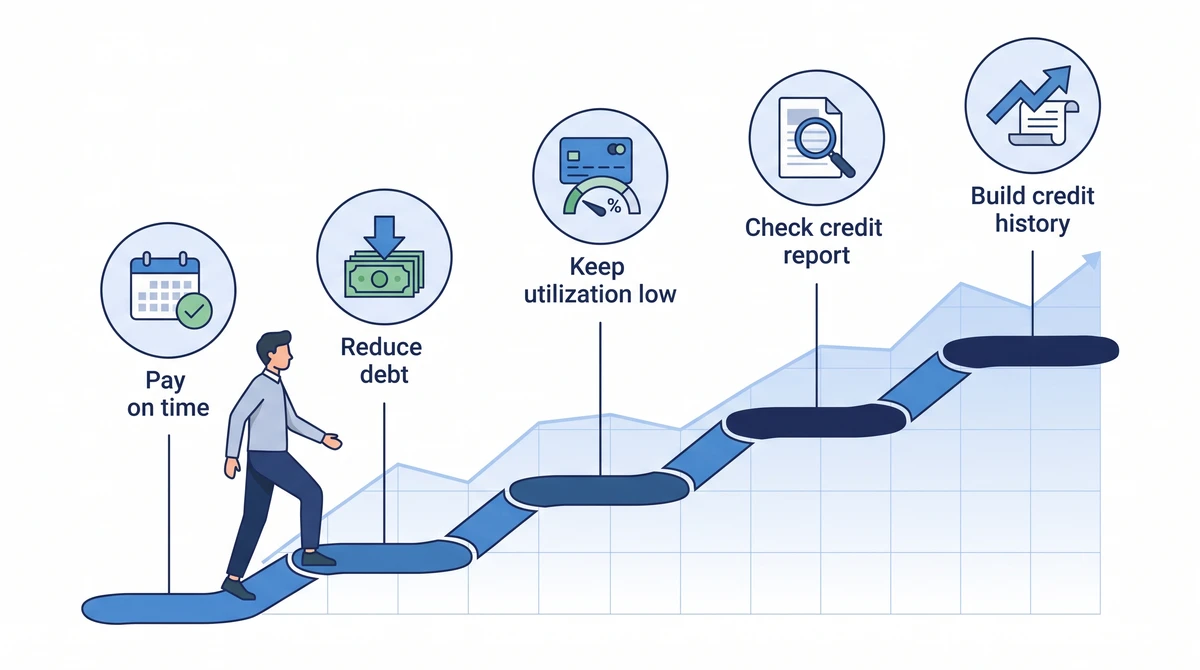
The most effective strategies are:
1. Make sure to pay all your bills promptly.
This is the most important habit for a great many people.
Set up:
Automatic payments
Calendar reminders
Banking notifications
Payment alerts
If you've missed payments, make them up as soon as you can, then keep making them regularly afterward.
The more responsibly you make payments over time, the better your credit record will become.
2. Maintain low balances on your credit cards.
Avoid using a large portion of your available revolving credit.
For example:
Total credit limit: $10,000
Balance: $2,000
Utilization: 20%
That is generally preferable to:
Total credit limit: $10,000
Balance: $9,000
Utilization: 90%
Even if you can afford the payment in principle, very high utilization can negatively affect your credit score.
3. Pay Credit Card Balances in Full When Possible
Just because you carry a balance doesn't mean that your credit score will be healthier.
If your financial position permits, you can avoid paying interest by paying the full amount shown on the statement while using credit responsibly.
Remember:
You don't need to pay interest to build credit.
That specific myth must have brought lenders a great deal of happiness over the years.
4. Do not apply for too much credit all at once.
Before applying for another credit card or loan, ask yourself:
Do I really need this credit?
If the answer is no, don't apply just because you received an attractive offer.
If you apply for multiple lines of credit in a short time, this could result in additional hard inquiries and affect your credit record.
5. Do not close accounts without taking into account the consequences.
Closing an old credit account isn't always advantageous.
The impact on factors like your available credit and credit utilization depends on the scoring model and your overall credit profile.
Before closing an account, consider:
Its age
Its credit limit
Whether it has an annual fee
Whether you actually need it
How closing it would affect your overall utilization
The right choice depends on your circumstances.
6. Check your credit reports for any errors.
Errors in credit reporting may potentially lower your score.
Review your credit reports and look for things such as:
Accounts you don't recognize
Incorrect balances
Incorrect payment history
Duplicate accounts
Incorrect personal information
Accounts listed as open when they were closed.
When you spot an error, follow the dispute procedure offered by the credit reporting organization in question and the company that provided the information.
It is one of the few methods for improving your credit that can make a real difference without incurring any new debt.
7. Allow your credit time.
Improving one's credit is generally a long-term affair.
You can't press a magic button to turn a bad credit record into a good one overnight.
The most sustainable approach is:
Pay on time, manage your debt, keep your utilization reasonable, avoid unnecessary credit applications, monitor your reports, and repeat these steps for years.
Consistency beats financial gimmicks.
How long does it take to boost your credit score?
It all comes down to the reason why your score is low.
Someone with a high credit utilization rate might see a difference after reducing their balances, and the updated information then gets passed on to the appropriate reporting systems.
Someone with a record of serious late payments might have to wait longer, since adverse information can stay on credit reports for many years.
For instance, in the United States, credit reporting companies can generally report negative payment information for up to seven years, while positive information can stay on record longer. Rules differ by country and by the type of information.
The important point is:
Improving your credit is a process, not a single event.
Does checking your own credit score affect it?
In general, checking your own credit score has no effect, unlike applying for credit, which causes a hard inquiry.
Credit scoring systems can tell the difference between various kinds of credit inquiries.
A soft inquiry occurs when you check your own credit information or when companies review your credit record for reasons other than assessing a new application.
A hard inquiry takes place when a lender checks your credit as part of a credit application.
Hard inquiries may affect certain credit scores, whereas soft inquiries usually do not.
The specific rules vary by scoring model and jurisdiction.
Common Credit Score Myths
Myth 1: You need an unpaid balance on a credit card to build credit.
False.
You usually don't need to take on debt and pay interest to build a good credit history, and it is financially advisable to pay your balance in full whenever you can.
Myth 2: Checking your own credit score damages it.
False.
A credit check is usually treated differently than a hard inquiry tied to a credit application.
Myth 3: There is only one credit score.
False.
You can have several credit scores because different scoring models, credit reporting agencies, lenders, products, and calculation dates can produce different results.
Myth 4: Closing a credit card will always positively affect your credit.
False.
The impact of closing an account on your available credit and possibly on your utilization will depend on your overall credit profile.
Myth 5: You need to achieve a perfect score to obtain a loan.
False.
Lenders have their own eligibility criteria, and a credit score is only one factor they consider in lending decisions.
Myth 6: You can quickly fix bad credit by paying a company.
Be skeptical.
Improving your credit legitimately requires time and responsible financial behavior.
Be especially careful with companies that promise to eliminate accurate negative information or guarantee an immediate improvement in your credit score.
What if you have no credit history?
To have no credit history is different from having bad credit.
You probably don't have a credit history because you haven't borrowed money or used a credit product that has been reported.
Depending on your country and available financial products, possible ways to establish credit may include:
A secured credit card
A credit-builder product
A small appropriate loan
Becoming an authorized user on an established account, where applicable
Responsibly managing an account that reports payment activity.
The important principle is:
Avoid borrowing money you don't need to establish a credit score.
Building your credit should support your financial goals rather than lead to unnecessary debt.
What if your credit score is bad?
A poor credit score doesn't mean you are permanently in a difficult situation.
The first step is to determine the cause.
If you have missed payments:
Make sure to make current payments and keep them up to date.
If your credit utilization is high:
Make a plan for paying off debt and lower your revolving balances.
If your credit report contains errors:
Dispute inaccurate information.
If you have too many recent applications:
Don't apply for any unnecessary new credit and let your credit record stabilize.
If your credit history is short:
Use credit responsibly and keep doing so over time.
The answer varies according to the problem.
A Simple Credit Score Improvement Plan
If you want a practical starting point, use this checklist:
Every month
Pay every credit account on time.
Keep credit card utilization under control.
Avoid unnecessary borrowing
Review account statements
Watch for suspicious activity.
Every few months
Review your credit reports where available.
Check balances and account information.
Look for unfamiliar accounts or inquiries.
Review your debt repayment progress.
Before applying for a major loan
Check your credit reports.
Correct errors
Reduce high revolving balances if possible.
Avoid unnecessary new credit applications.
Compare lenders and loan terms.
This method is far less exciting than an advertisement that says "boost your score by 100 points overnight", but it does have the advantage of being rooted in the way credit actually works.
How Credit Scores Fit Into Your Overall Financial Health
While a good credit score is useful, it shouldn't be your only financial aim.
You can have an excellent credit score and still have:
Too much debt
Insufficient emergency savings
Poor spending habits
Little retirement savings
No investment strategy
Your credit score is one element of your financial well-being.
A stronger financial foundation also includes:
Building an emergency fund
Controlling high-interest debt
Maintaining a realistic budget
Saving consistently
Investing according to your goals and risk tolerance
Protecting yourself with appropriate insurance
Increasing your income and financial resilience
The aim is not just to end up with a nice three-digit number.
The aim is to have financial flexibility.
Frequently Asked Questions About Credit Scores
What constitutes a credit score?
A credit score is a number calculated from your credit history and used to predict how likely you are to repay borrowed money.
What counts as a good credit score?
There isn't a general notion of a "good" score because different scoring models and ranges are used; when a scale goes from 300 to 850, higher scores usually indicate lower credit risk.
How can a credit score be improved most quickly?
There isn't a one-size-fits-all solution; depending on the reason for your low score, timely payments, lowering high credit utilization, fixing errors, and avoiding new credit applications can all help.
Will paying off a credit card cause your credit score to rise?
It can; by reducing your revolving balances, you lower your credit utilization, which helps your score, and making each payment on time also improves your payment history.
Should I take a balance to establish my credit?
You usually don't need a balance or to pay interest to demonstrate responsible credit behavior.
Will a late payment hurt your credit score?
A late payment report can negatively affect your credit rating; the extent depends on factors such as how late the payment was, when it occurred, and your overall credit history.
How long does a bad credit rating stay?
It depends on the type of adverse information and the laws governing credit reporting in your country; in the United States, for example, some negative payment information can generally stay on credit reports for up to seven years.
May I have more than one credit score?
Yes, different scoring models, credit reporting agencies, lenders, loan products, and the dates used for calculations can lead to different scores.
Will closing a credit card negatively affect your credit score?
That depends on your situation; closing an account can affect your available credit and utilization rate, among other factors.
How frequently should you check your credit report?
It's a good idea to check your credit information regularly, especially when you're applying for a large loan. The exact amount and frequency of free reports you can get will vary by country and credit reporting system.
Final Thoughts
A credit score consists of more than just a number.
It gives a statistical overview of the way in which you have managed credit, and lenders may use it to estimate the risk of lending to you.
The fundamentals are surprisingly simple:
Pay on time.
Make sure that the balances on your revolving credit remain under control.
Avoid unnecessary applications.
Manage your accounts responsibly over time.
Look through your credit reports to make sure there are no errors.
You shouldn't borrow money to boost your score.
You can't build a strong credit record with tricks or shortcuts; it comes from steady financial behavior over months and years.
That's good news.
You don't need to become a financial genius to boost your credit—just adopt a system that helps you practice responsible financial behavior consistently.
Build the habit, protect your credit history, and give it time to do some of the work for you.
Admin
Finance writer and investment analyst at FinFlexa, helping readers make smarter money decisions with data-backed guides and calculators.